

Stone as a Building Material
Stone as a Building Material has been used for centuries because of its strength, durability and natural appearance. It is obtained from rocks in the earth’s crust and can be prepared in different forms for construction. Engineers and builders select stone according to its geological, physical, chemical and hardness characteristics.
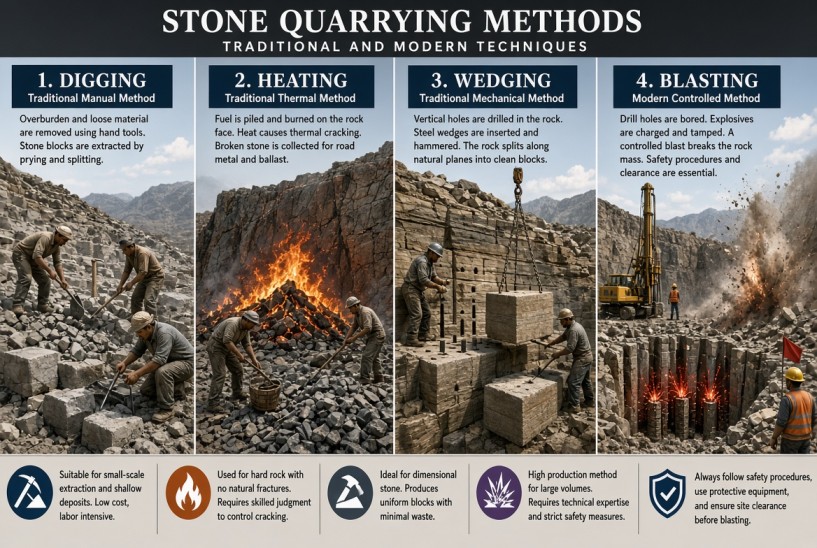
Table of Contents
Classification of Rocks
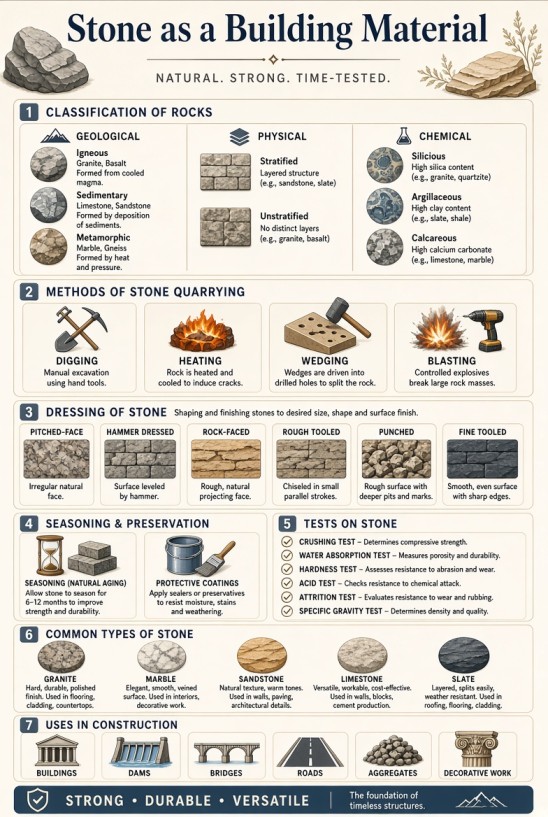
Understanding rock classification is important when studying stone as a building material. Rocks can be classified according to geological, physical, chemical and hardness characteristics.
1. Geological Classification
Igneous rocks form when molten lava cools and solidifies. Granite and trap or basalt are common examples.
Sedimentary rocks form through the gradual deposition of disintegrated rocks, vegetable matter and clay at the bottom of rivers, lakes or seas. Limestone and sandstone are examples.
Metamorphic rocks form when igneous or sedimentary rocks undergo great heat and pressure. Marble and gneiss are common examples.
2. Physical Classification
Stratified rocks have distinct layers and can generally split along their strata. Limestone, slate and sandstone are examples.
Unstratified rocks do not show distinct strata and cannot easily split into slabs. Granite, trap and marble are examples.
3. Chemical Classification
According to chemical composition, rocks are classified as:
- Silicious rocks – contain silica as the main constituent.
- Argillaceous rocks – contain clay or alumina.
- Calcareous rocks – contain calcium carbonate or lime.
Rocks can also be classified according to hardness as very hard, hard, medium and soft rocks. These classifications help determine the appropriate application of stone as building material.
Methods of Stone Quarrying
Quarrying is the operation of obtaining useful natural stone from a rock mass. The open part of natural rock from which useful stone is obtained is called a quarry. The main methods of quarrying are digging, heating, wedging and blasting. Proper quarrying is an important stage in preparing stone as a building material.
Digging
Digging is used when stones are buried under earth or loose overburden. Workers use tools such as shovels, pickaxes, hammers and chisels to remove the covering material and obtain the stone.
Heating
In the heating method, fuel is collected over exposed rock and burned for several hours. Unequal expansion caused by heating helps separate the rock from the colder mass. This method is mainly suitable for obtaining small pieces required for road metal, railway ballast and aggregates.
Wedging
In wedging, steel wedges are inserted into vertical fissures and hammered. Vertical holes of about 10–15 cm are generally made approximately 10 cm apart. The rock cracks along the line of least resistance. This method is suitable for sedimentary and softer stones such as sandstone, limestone, slate and marble.
Blasting
Blasting uses explosives to break and remove rock. The main operations include boring, charging, tamping and firing. It can be used for quarrying and for removing rock during foundation work, road structures and tunnelling.
Dressing of Stone
Dressing is the process of shaping and finishing stone with hand tools to obtain the required size, shape and surface. It improves the appearance of stone masonry, makes the stone suitable for construction requirements and can make transportation easier and more economical. Proper dressing improves the quality and appearance of stone as a building material.
Common dressing patterns include:
- Pitched-faced dressed
- Hammer dressed
- Rock-faced and chisel-faced
- Rough tooled
- Punched dressed
- Close picked
- Fine tooled
Preservation of Stone
Stone can deteriorate because of atmospheric agencies, moisture, plant growth and other environmental effects. Preservation aims to improve the ability of stone to resist deterioration. Preservation is therefore an important consideration when using stone as a building material.
Common preservation methods include:
- Filling the pores of the stone.
- Applying a preservative coating to prevent moisture from entering the pores.
- Using suitable binding material that does not adversely affect the stone.
- Preventing the growth of plants and trees on the stone.
Preservatives mentioned in the study material include coal tar, linseed oil, paint and a solution of alum and soap.
Seasoning of Stone
After quarrying and dressing, good stone should be free from quarry sap before it is used in construction. The material recommends leaving stone for approximately 6 to 12 months for proper seasoning. This process allows the stone to become free from quarry sap and prepares it for construction use. Proper seasoning contributes to the durability of stone as a building material.
Tests Conducted on Stone
Engineers can conduct different tests to evaluate the quality and suitability of stone. Important tests include:
- Smith’s test
- Freezing and thawing test
- Frost action test
- Acid test
- Water absorption test
- Microscopic examination
- Impact test
- Attrition test
- Crushing test
- Crystallization test
- Hardness test
These tests help assess properties related to strength, durability, absorption and resistance to different environmental or mechanical actions. Testing is essential for determining the suitability of Stone as a Building Material for particular construction purposes.
Common Types of Building Stone
Granite
Granite is an igneous rock containing quartz, felspar and mica. It is strong and durable, and finely grained granite can take a fine polish. Its uses include ornamental columns, plinths, sea walls, lighthouses and bridge piers. These properties make granite an important option for stone as building material.
Marble
Marble is a metamorphic rock of calcareous variety formed from limestone. It is crystalline, hard and compact and can take a fine polish. It is used for carving, decorative work, steps, wall linings, electrical switch boards, table slabs and columns.
Sandstone
Sandstone is a sedimentary rock of silicious variety. Fine-grained sandstone is strong and durable and can be used for ashlar work, mouldings and carvings. Rough and coarse-grained sandstone can be used for rubble work.
Limestone
Limestone is a sedimentary rock of calcareous variety. In its pure state, it contains calcium carbonate. It is used for stone masonry walls, paving set in floors and road metal.
Slate
Slate is a metamorphic rock that is hard, tough and fine grained. It can split into thin sheets and has good durability. Its uses include electrical switch boards, cisterns, urinals and partition walls.
Uses of Stone in Construction
Stone as building material has many applications in civil and building construction. Major uses include:
- Residential buildings
- Public buildings
- Dams
- Harbors
- Bridge abutments
- Road metal
- Railway ballast
- Concrete aggregate
- Plinths and columns
- Decorative and carving work
The selection of stone depends on the required strength, durability, appearance and intended use. Different varieties provide different advantages, making stone as building material suitable for both structural and decorative applications.
Importance of Proper Stone Selection
Selecting the correct material is essential for successful construction. The classification, quarrying method, dressing quality, preservation and seasoning of stone all influence its performance. Engineers should also consider the results of relevant tests before selecting stone as a building material for a particular project.
Granite, marble, sandstone, limestone and slate have different properties and applications. Understanding these differences helps construction professionals use stone as building material effectively and economically.
Conclusion
Stone as a building materials remains important because of its strength, durability and wide range of applications. Understanding rock classification, quarrying, dressing, preservation and seasoning helps construction professionals select and prepare suitable stone. Granite, marble, sandstone, limestone and slate each have different properties and uses, making proper selection important for safe and durable construction.
Enhance your interior journey with the Interior Dreams
- Collaborate with Interior Dreams
- Showcase your projects.
- Experience the world of interior architecture.

Leave a Reply