

Clay
It is a special kind of earth that forms when weathering breaks down rocks. The lecture notes identify two
main forms of clay. Primary it remains near the place where the original rock decomposed, while
secondary moves from its original location through water, air, or ice and becomes deposited elsewhere.
The building industry uses clay extensively because manufacturers can shape it, dry it, and burn it into
useful construction products. The main clay products include bricks, tiles, terracotta,
earthenware, stoneware, and porcelain.
Table of Contents

Tiles form an important group of clay products. A tile consists of a thin slab of brick earth that workers burn
in a kiln. Because tiles are thinner than ordinary bricks, they can crack, warp, or break more easily during
drying and burning. Therefore, workers dry tiles in shade, burn them carefully, and cool them gradually.
The manufacture of common tiles follows four main stages: preparation of clay, moulding, drying, and burning
Making Process
During its preparation, workers remove grit, pebbles, and other impurities. They grind the selected material
into powder and thoroughly pug it. For superior tiles, workers mix the powdered clay with a large quantity of
water in tanks and stir the mixture. The heavier and coarser particles settle at the bottom, while finer ones
moves into another tank. Workers then allow the fine clay to dry. This method the blunging
process. Workers use different methods to mould tiles. They use well-seasoned wooden patterns when a tile does
not maintain a uniform section throughout its length. They use a potter’s wheel when the tile has a circular
shape. They use mechanical moulding when the tile has a uniform section throughout its length. After
moulding, workers correct irregularities and leave the tiles under shade for about two days. This controlled
drying helps prevent warping and cracking before the kiln stage. Workers burn tiles in specially prepared kilns. Gradual heating, controlled firing, and gradual cooling. A good tile should have uniform colour, proper burning, freedom from cracks and bends, suitable shape and size, hardness, durability, and a clear ringing sound when struck.
This classify tiles into :
- Roofing
- Flooring
- Wall
- Drain
- Glazed earthenware
Roofing tiles must remain strong, durable, and leak-proof because they face atmospheric exposure. Flooring tiles commonly have
square or rectangular shapes. Wall tiles receive glazing and further firing, while drain tiles use curved
sections to carry wastewater. Roofing tiles include flat, pot or country, Allahabad, corrugated, Mangalore, ridge, valley, and lip tiles.
Flooring tiles should have clean, dense fractured surfaces and suitable water absorption. These examples
show how manufacturers adapt clay products to different building functions and performance requirements
in roofs, floors, walls, drainage, sanitation, decoration, and electrical applications. Workers use flat, pot,
Allahabad, corrugated, Mangalore, ridge, valley, and lip tiles for different roofing arrangement
Products
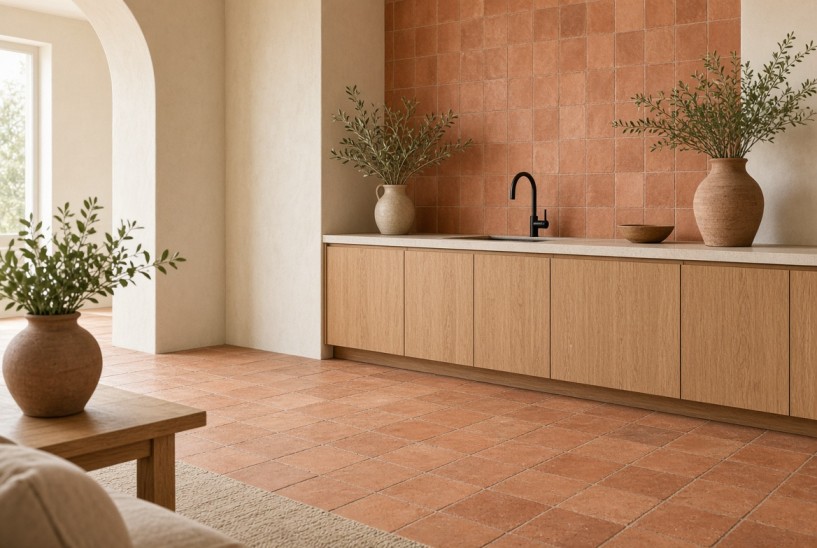
Mud also produces several other useful products. Earthenware uses ordinary clay mixed with sand or
crushed pottery and fired at a low temperature. Terracotta provides a high-quality earthenware product that
can substitute for stone in ornamental work. It is light, strong, durable, available in several colours, and easy
to mould. Porcelain consists of fine, white, thin, and semi-transparent earthenware prepared from clay,
feldspar, quartz, and minerals. Manufacturers use it for sanitary ware and electrical insulators. Stoneware
uses refractory clay mixed with crushed pottery or powdered stone and fired at high temperature. It
becomes hard, durable, moisture-resistant, and easy to clean, so builders use it for drains, sewer pipes,
sanitary ware, and chemical vessels. Glazing adds a transparent or opaque film to protect clay products and
improve their appearance.
Enhance your interior journey with the Interior Dreams
- Collaborate with Interior Dreams
- Showcase your projects.
- Experience the world of interior architecture.

Leave a Reply