

Table of Contents
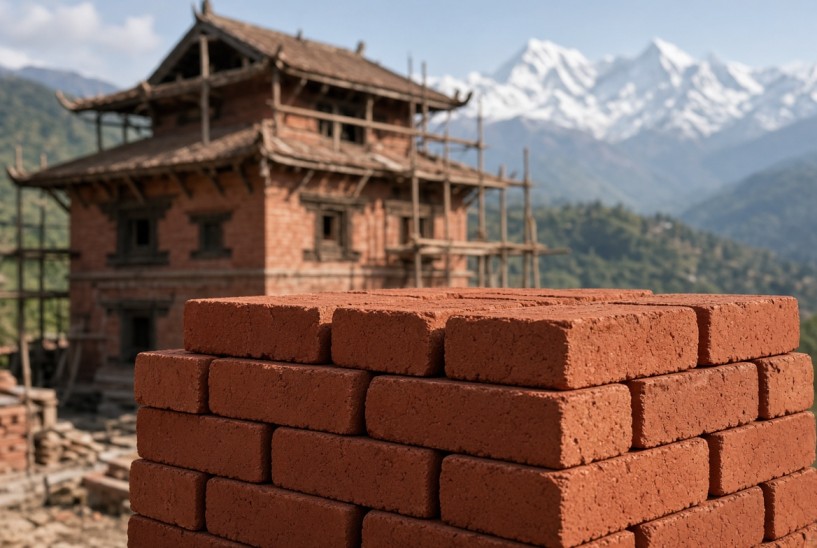
Bricks in nepal are one of the most common and trusted building materials used in construction around the world. They’re strong, durable, reliable, and relatively affordable. Their regular shape and size make it easy for masons to build neat, even walls with consistent joints. From house walls and foundations to boundary walls and other structures, bricks play a big role in almost every type of building work.
The quality of a bricks in Nepal depends mainly on the clay used and how carefully it is prepared, moulded, dried, and burnt. Good brick earth contains a balanced mix of important ingredients:
- Alumina (clay) gives the brick plasticity so it can be easily moulded.
- Silica (sand) adds hardness and prevents too much shrinkage or cracking.
- Lime helps the silica melt and bind everything together during burning.
- Iron oxide gives bricks their familiar red colour and also increases strength.
- Magnesia, when present in the right amount, helps reduce shrinkage.
Harmful materials like limestone nodules (kankar), alkalies, pebbles, iron pyrites, or organic matter should be avoided. These can cause cracking, uneven burning, or make the brick too porous.
A good brick should look uniform in colour and have a clean rectangular shape with flat faces, parallel sides, and sharp right-angled edges. When broken, it should show a compact, even structure. It should produce a clear metallic ringing sound when struck, resist scratching, and have good strength. It should also stand up well to fire, efflorescence (white salt deposits), and weathering.
Types of Bricks in Nepal
Bricks in Nepal are mainly of two kinds:
Sun-dried (Katchha)
These are simply dried in the sun. They are cheap and suitable for temporary or low-cost structures, but they should not be used in places that get heavy rain.
Burnt (Pacca)
These are properly burnt in clamps or kilns after moulding and drying. They become much harder, stronger, and more durable, making them ideal for permanent construction.
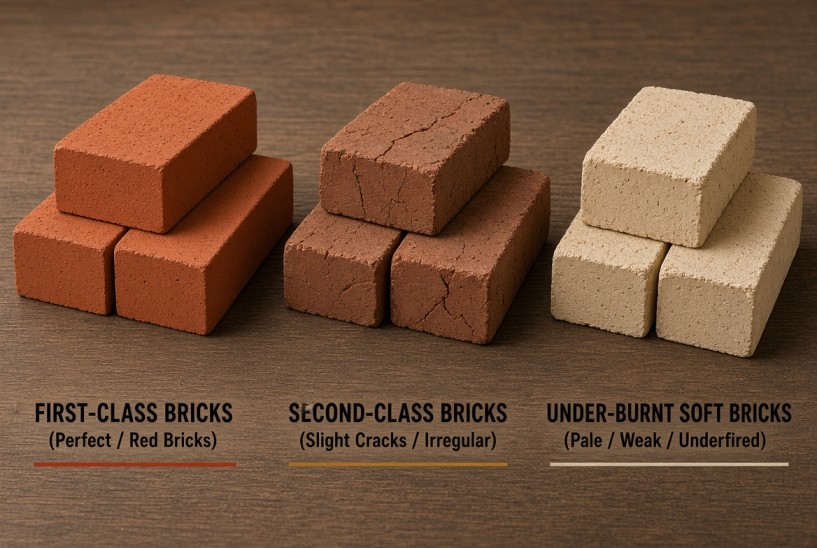
Burnt bricks are further graded as:
- First-class bricks – Well-burnt, regular shape, sharp edges, clean surfaces, no cracks. Water absorption should not exceed 20% of dry weight, and they should not show efflorescence.
- Second-class bricks – Slightly irregular or with minor surface cracks, but still well-burnt and usable for most work.
- Third-class bricks – Under-burnt, softer, and lighter in colour. Suitable only for less important work.
- Over-burnt bricks – Become hard and distorted (vitrified). These are better used as road metal or aggregate rather than for masonry.
- Under-burnt bricks – Lack strength. They can be re-burnt or crushed into powder (surkhi).
How Bricks In Nepal Are Made
Bricks in Nepal manufacturing involves several careful steps:
- Preparing the clay – Choose a good site, remove the topsoil, clear stones and plant matter, break up lumps, and let the clay weather. Then blend it with sand and the right amount of water.
- Pugging (tempering) – Knead the clay thoroughly until it becomes a smooth, homogeneous mass. This is often done in a pugmill.
- Moulding – Bricks can be moulded by hand (on the ground or on a table) or by machine for larger production.
- Drying – Bricks are dried either naturally (stacked with air gaps) or in artificial driers.
- Burning – The final step that gives bricks their hardness, strength, and low water absorption. Burning can be done in open clamps, intermittent kilns, or continuous kilns.
Proper drying and burning are essential for producing strong, long-lasting bricks in Nepal.
Brick manufacturing follows preparation of clay, pugging or tempering, moulding, drying, and burning.
Workers select a suitable site, remove the top layer of soil, clean stones and vegetable matter, break soil
lumps, and allow the clay to weather. They blend the clay with other ingredients such as sand and add a
suitable quantity of water. During pugging, workers knead and water the clay until it forms a homogeneous
mass. A pugmill performs this operation mechanically.
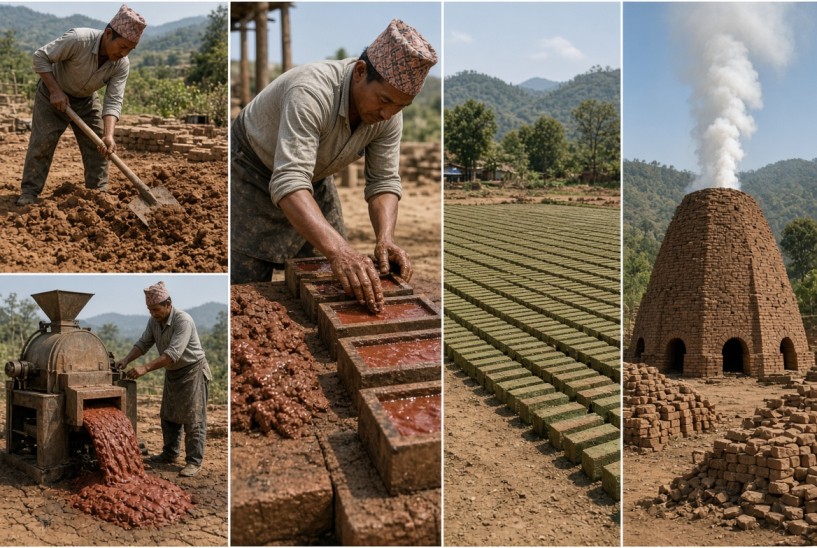
Workers mould bricks by hand or machine. Hand moulding includes ground moulding and table moulding,
while machine moulding suits large-scale production. After moulding, workers dry bricks naturally by
arranging them with spaces for air circulation or artificially in driers. Finally, they burn the bricks to increase
hardness and strength, increase density, and reduce water absorption. The notes describe clamp or open
kilns, intermittent kilns, and continuous kilns as methods of brick burning.
Natural drying arranges bricks with air spaces, while artificial drying uses driers for large quantities. This
supports production requirements.
Enhance your interior journey with the Interior Dreams
Bring your vision to life with Interior Dreams. We specialize in innovative interior design, space planning, 3D visualization, and custom solutions that blend functionality, comfort, and elegance to create spaces you’ll love.
- Collaborate with Interior Dreams
- Showcase your projects.
- Experience the world of interior architecture.

Leave a Reply